After months of advocacy, testimony, and tireless work by our school leaders, families, students, lobby team, and the WA Charters staff, the 2026 Supplemental State Operating Budget has been finalized without the critical $7.5 million enrichment funding that Washington’s charter public school students rely on.
Collectively, we’ve spent years fighting for the students in our public schools. After more than a decade, it is clear that charter public schools are an integral part of the public education landscape in Washington state. We are delivering positive outcomes for kids, we are meeting our mission of identifying best practices that can be scaled in classrooms across the state, and we aren’t going anywhere.
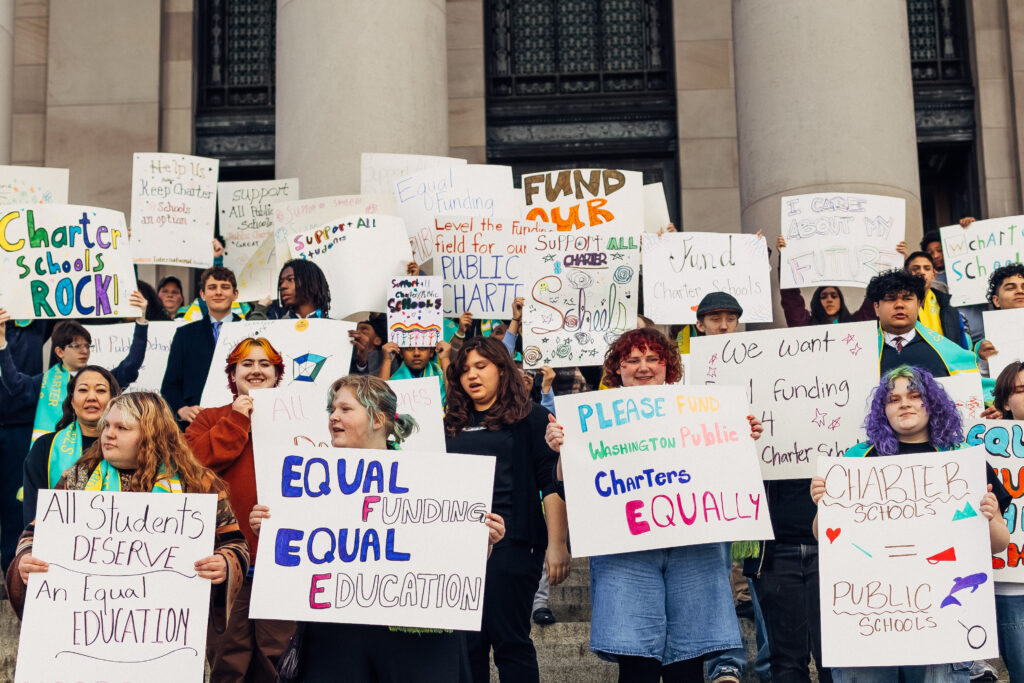
Unfortunately, today, the Legislature told charter public school students — through their inaction — that they don’t matter as much as every other public school student in this state. Inaction by elected officials has pitted students against each other and widened the funding gap that charter public school students have dealt with for years. This is wrong and we will not accept this quietly.
“Charter public school students are public school students. They are not asking for a special carve-out, they just want to be invested in,” said Chris Korsmo, Executive Director of Washington State Charter Schools Association. “It is disheartening that our Legislature has reversed its approach from the past two school years and made this inequity in our public school system worse. These students are asking for the same support as every other public school student in Washington – they deserve to be believed in.”
Washington’s charter public schools serve thousands of students, most of whom are from low-income families and communities that have been historically underserved, which the Legislature has recognized. Failure to provide equitable funding risks eliminating services for the students who rely on them the most. Losing this funding does not just affect school budgets — it directly impacts whether these students continue to have access to the public school that best fits their educational needs.
Without this funding, our schools face impossible choices: cutting the teachers and staff who show up every day for kids, eliminating the academic interventions that are often a lifeline for students who have struggled in traditional settings, and in the worst cases, closing their doors entirely.
These are public school students, and they deserve better. We’ve spent years fighting for these students, and we won’t stop now.